
Search the Site with

|
Search the Site with
|
 History About the Construction About the Smart Ship Project The Baselines of the Class General Characteristics Gallery to end of page
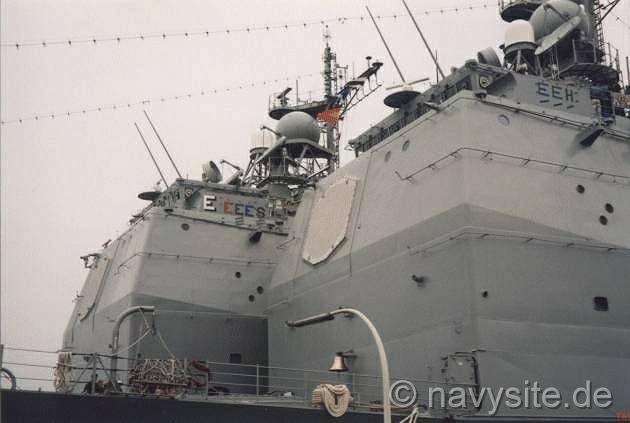
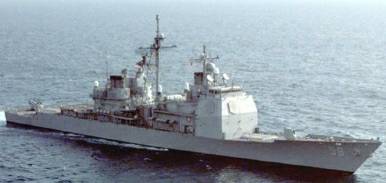
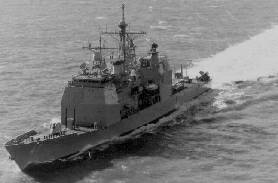
The TICONDEROGA - class consists of the 27 most expensive cruisers and the most powerful surface combatants in service in the world. The high price of about $1 billion is a result of the
Due to their extensive combat capability, these ships have been designated as Battle Force Capable (BFC) units. Their primary armament is the Vertical Launching System (VLS) which is able to employ both the long range surface-to-surface Tomahawk Cruise Missile and the Standard Surface-to-Air Missile. These multi-mission ships are capable of sustained combat operations in any combination of Anti-Air, Anti-Submarine, Anti- Surface, and Strike warfare environments. They are built to be employed in support of Carrier Battle Groups, Amphibious Assault Groups, as well as interdiction and escort missions.
TICONDEROGA class cruisers are named after famous American Battles (with the exception of USS THOMAS S. GATES).
 back to top go to the end of the page
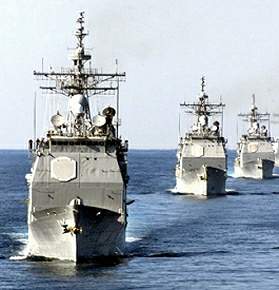 The development of this class started in the 1970th. Initially designated as Guided Missile Destroyers (DDG), the TICONDEROGAs were redesignated as Guided Missile Cruisers (CG) on January 1, 1980. The hull and the propulsion system of the SPRUANCE class were the basis for this new class of guided missile ships but
The TICONDEROGA - class cruisers were the first surface combatant ships equipped with the
During the construction of the SPRUANCE class destroyers there was a contract that Ingalls had to deliver the ships ready for commissioning. That meant that all combat systems were ordered and installed by Ingalls. During the construction of the TICONDEROGA class the Navy has been more active. The Navy helped with the blueprints and was responsible to provide the Combat Systems.
The first cruiser, the TICONDEROGA, was ordered and authorized in FY 1978.
The first five ships don't possess the power of the final units. The main reason for this deficit is the
Early plans considered to decommission these five ships, equip them with
There are varying capabilities between Baselines 2, 3 and 4. The cruiser conversion program will result in all 22 ships having a common baseline. The core components of the combat systems cruiser conversion include:
Also included in the conversion is the “all-electric modification” which will eliminate waste heat boilers and associated equipment, replace steam-operated equipment with electric equipment - including laundry washers and dryers, galley kettles, dishwashers, lubrication and fuel oil heaters and potable water heaters with equivalent electrical equipment. It will replace flash type distilling plants with reverse osmosis units capable of treating potable water. The reverse osmosis units are easier to maintain, more reliable and do not create high temperatures in the work spaces, which reduces heat stress and improves shipboard quality of life.
CG 47 - CG 51 will not receive the conversion and will be decommissioned by 2006, starting with the TICONDEROGA (CG 47) in 2004.
back to top go to the end of the pageThe ships of the TICONDEROGA - class were built in sections, called modules, which allowed improved access to all areas of the ship during construction. The modules were then moved together to form the hull of the ship, and the deckhouse sections were then lifted aboard. For launching, the ship was moved several hundred yards across land to the floating dry dock, which was used to actually launch the ship.
During their construction, hundreds of subassemblies were built and outfitted with piping sections, ventilation ducting, and other shipboard hardware. These subassemblies were then joined to form modules, which were then outfitted with larger equipment items, such as propulsion and power generation machinery and electrical panels. This represents an advancement from traditional shipbuilding in which these systems are installed in tight quarters below decks after the hull is completed. At Ingalls, four of these pre-outfitted hull and superstructure modules were joined together to form the ship shortly before it was moved to the water's edge and launched.
At the shipyards, this modular process is supported by an extensive Computer-Aided Design (CAD)/Computer-Aided Manufacturing (CAM) program that has significantly enhanced the efficiency of detail design, and has reduced the number of manual steps involved in converting design drawings to ship components. The three-dimensional CAD system is linked with an integrated CAM production network of computers throughout the shipyard. The CAD system directs the operation of numerically-controlled manufacturing equipment used to cut steel plates, cut and bend pipe, and form sheet metal assemblies.
Launching involved movement over land via a wheel-on-rail transfer system onto the shipyard launch and recovery dry dock, which was ballasted down in order for the ship to float free and moved to an outfitting berth in preparation for the traditional christening ceremony. Upon completion of post-launch outfitting, the cruisers went through an extensive dockside and at-sea testing period to ensure the ship and crew were ready to safely go to sea.
back to top go to the end of the page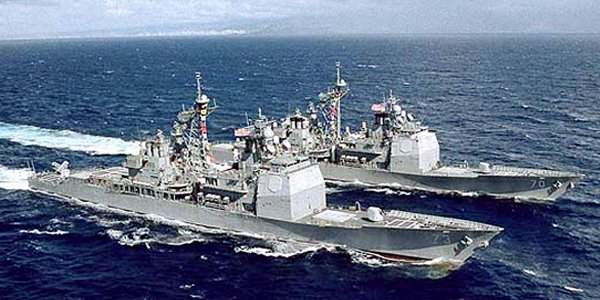 back to top go to the end of the page
The Smart Ship Project was initiated by an October 1995 brief from the Naval Research Advisory Committee (NRAC) panel on reduced manning to the Chief of Naval Operations. Their report stated that the major obstacle to reduced crew size and decreased life cycle costs aboard Navy ships was culture and tradition rather than the lack of proven technology and know-how. The challenge was to demonstrate in an operational ship that reductions in workload and crew requirements were possible while maintaining mission readiness and safety. The Commander, Naval Surface Force, US Atlantic Fleet (COMNAVSURFLANT) was designated as Executive Agent for the Smart Ship Project and nominated USS YORKTOWN (CG 48) as the ship in which to implement ideas to demonstrate the concept.
Smart Ship "Core Technologies":
All approved Smart Ship initiatives were implemented aboard YORKTOWN prior to her deployment in December 1996. Huge chunks of the ship were torn up and thrown away and replaced by computer consoles and miles of fiber optic cable.
With all policy and procedure, technology, and maintenance initiatives implemented, crew reductions enabled by the decrease in workload were 44 enlisted personnel and 4 officers The Smart Ship Project demonstrated that shipboard workload reductions are possible while maintaining combat readiness and safety with significant net positive return on investment. Expenditures on available technology and implementation of policy and procedure changes make crew size reductions achievable. The required expenditures for such changes are offset by large potential savings, both shipboard and ashore, and in operations and maintenance costs aboard ship. Technology, taken as a single package as installed in YORKTOWN, returns the investment in seventeen years. However, some of the individual technologies demonstrate a more positive return-on-investment.
back to top go to the end of the page| The Baselines of the Ticonderoga class | ||
|---|---|---|
| Baseline 0 | ||
| ||
| Baseline 1 | ||
| ||
| Baseline 2 | ||
| ||
| Baseline 3 | ||
| ||
| Baseline 4 | ||
| ||
go to the end of the page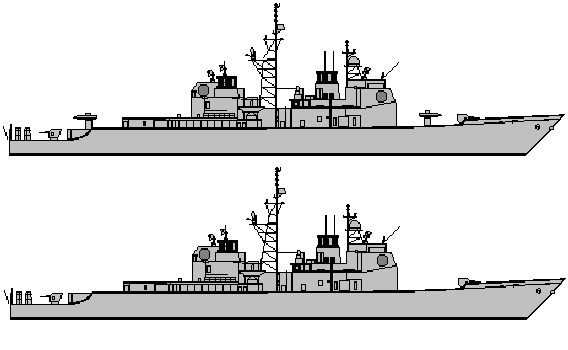 back to top go to the end of the page
| General Characteristics - Ticonderoga class | |
|---|---|
| Builders: | Ingalls Shipbuilding, West Bank, Pascagoula, Miss.: CG-47-50, CG 52-57, 59,62, 65-66, 68-69, 71-73 Bath Iron Works, Bath, Maine: CG-51,58,60-61,63-64,67,70 |
| Power Plant: | 4 General Electric LM-2500 Gas Turbine Engines (80,000 Shaft Horsepower) 2 Controllable-Reversible Pitch Propellers 2 Rudders |
| Length: | 567 feet (173 meters) |
| Beam: | 55 feet (16.8 meters) |
| Draft: | 34 feet (10.2 meters) |
| Displacement: | approx. 9,600 tons full load |
| Speed: | 30+ knots |
| Range: | 6,000 nautical miles @ 20 knots |
| Crew: | 33 Officers, 27 Chief Petty Officers, approx. 340 enlisted |
| Sensors: | Earlier Ships: 1 AN/SPY-1A Radar (Four Arrays)(CG 47 - CG 58) 1 AN/SPS-49 Air Search Radar 1 AN/SPS-55 Surface Search Radar 1 AN/SPQ-9 Gun Fire Control Radar 4 AN/SPG-62 Illuminators 1 AN/SQS-53A Hull Mounted SONAR (CG 47 - CG 55) 1 AN/SLQ-32(V)3 Electronic Warfare Suite Later Ships: 1 AN/SPY-1B Multi-Function Radar (CG 59 - CG 64) 1 AN/SPY-1B(V) Multi-Function Radar (CG 65 - CG 73) 1 AN/SPS-49(V)8 Air Search Radar 1 AN/SPS-55 Surface Search Radar 1 AN/SPS-64(V)9 Navigation Radar 1 AN/SPQ-9 Gun Fire Control Radar 4 AN/SPG-62 Illuminators 1 AN/SQS-53C Hull Mounted SONAR (CG 65 - CG 73) 1 AN/SQQ-89 ASW System (CG 56 - CG 73) 1 AN/SQR-19B Towed Array SONAR (TACTAS) 1 AN/SLQ-32A(V)3 Electronic Warfare Suite |
| Weapons Systems: | 1 MK 7 MOD 4 2 2 2 2 MK 32 MOD 14 Torpedo Tubes 2 MK 15 MOD 3 1 MK 36 MOD 2 Super Rapid-Blooming Off-Board Chaff System 3 50-Caliber Machine Guns |
| Command and Control: | MK 1 MOD 0 |
| Aircraft: | 2 LAMPS MK III |
| Annual Average Unit Operating Cost: | $28,000,000 |
| Date deployed: | January 22, 1983 (USS Ticonderoga) |
back to top go to the end of the page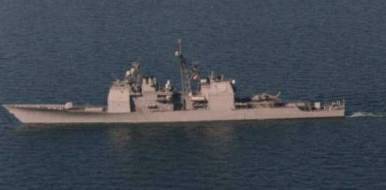 | 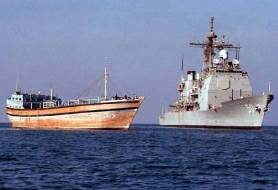 |
 |  |
back to top
 Back to Guided Missile Cruiser list. Back to Ship list. Back to selection page. Back to 1st page.